
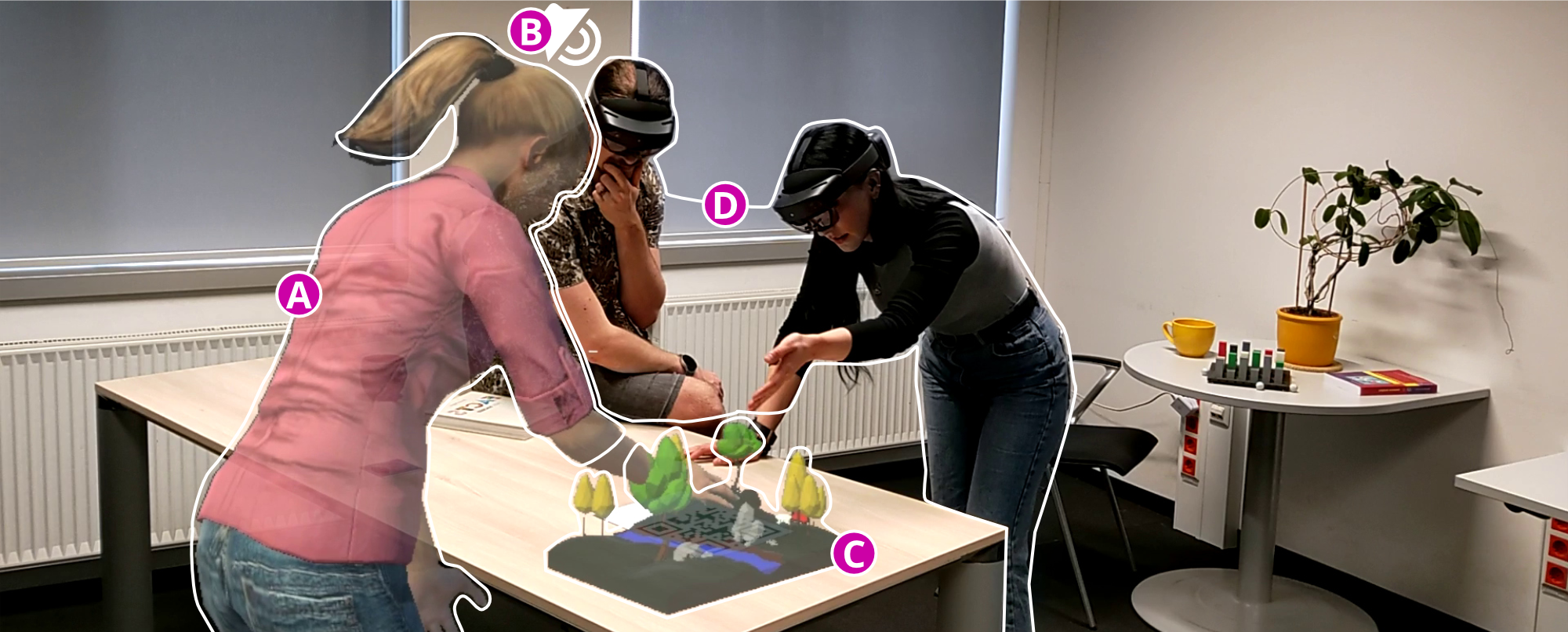
Our proposed definition of mixed-presence environments for Mixed Reality. They are distributed Mixed Reality environments, in which (A) remote actors have (B) a visual and/or auditory representation and (C) share a three-dimensional interaction and communication space with (D) co-located actors.
Full author list
Krug, K.; Büschel, W.; Satkowski, M.; Gumhold, S.; Dachselt, R.
Abstract
This paper investigates the challenges of designing mixed-presence environments for Mixed Reality and suggests future research directions derived from an expert workshop.
Developing mixed-presence systems is a complex undertaking that combines the intricacies of both co-located and distributed mixed-reality spaces. Current literature in this field describes various promising design and development approaches but lacks a systematic overview, resulting in fragmented solutions to re-occurring challenges. Therefore, we conducted a comprehensive review of mixed-presence and multi-user remote mixed-reality systems, categorizing the prevalent challenges faced during the development of such systems, but also current trends, common use cases, study tasks and methodologies. Supported by these results, we then conducted an expert ideation workshop to collect and structure promising future research directions. As a result, we provide a detailed resource to orient and prepare developers for probable challenges and support researchers in making informed design decisions for future mixed-presence studies in Mixed Reality.
Research Article
Related Publications
@inproceedings{krug2024safeguarding,
author = {Katja Krug and Wolfgang B\"{u}schel and Marc Satkowski},
title = {Safeguarding Sensations: Harm Prevention in Multisensory Distributed Mixed Reality},
booktitle = {Proceedings of 2024 IEEE International Symposium on Mixed and Augmented Reality Adjunct (ISMAR-Adjunct)},
series = {ISMAR '24},
year = {2024},
month = {10},
location = {Seattle},
doi = {10.1109/ISMAR-Adjunct64951.2024.00008},
publisher = {IEEE}
}Weitere Materialien
@inproceedings{bueschel2024research,
author = {Wolfgang B\"{u}schel and Katja Krug and Marc Satkowski and Stefan Gumhold and Raimund Dachselt},
title = {A Research Platform for Studying Mixed-Presence Collaboration},
booktitle = {Proceedings of 2024 IEEE International Symposium on Mixed and Augmented Reality Adjunct (ISMAR-Adjunct)},
series = {ISMAR '24},
year = {2024},
month = {10},
location = {Seattle},
doi = {10.1109/ISMAR-Adjunct64951.2024.00058},
publisher = {IEEE}
}Weitere Materialien
@misc{krug2024inclusivemr,
author = {Katja Krug and Juli\'{a}n M\'{e}ndez and Weizhou Luo and Raimund Dachselt},
title = {Don't Leave Me Out: Designing for Device Inclusivity in Mixed Reality Collaboration},
booktitle = {CHI 2024 Workshop on Designing Inclusive Future Augmented Realities},
year = {2024},
month = {5},
location = {Honolulu, HI, USA},
doi = {10.48550/arXiv.2409.05374}
}Weitere Materialien


Related Student Projects

Untersuchung des Einflusses von Mimik auf Kollaboration in Mixed Reality
Xiaoli Song 11. November 2024 bis 14. April 2025
Betreuung: Wolfgang Büschel, Katja Krug, Raimund Dachselt
Exploration nicht-visueller Wahrnehmung von virtuellen Personen in Mixed-Reality Räumen
Kenny Weidemann 15. August 2025 bis 14. November 2025
Betreuung: Katja Krug, Raimund Dachselt

Unterstützung der Wahrnehmung von Blicken in kollaborativen Mixed Reality Umgebungen
William Thimm 26. Mai 2023 bis 13. Oktober 2023
Betreuung: Katja Krug, Wolfgang Büschel, Marc Satkowski, Raimund Dachselt
The Effect of Eye Gaze and Facial Expressions on Avatar Representations in Mixed Reality [INF-PM-FPA, SS 24]
Xiaoli Song 16. Mai 2024 bis 2. September 2024
Betreuung: Katja Krug, Wolfgang Büschel

Unterstützung von Mixed Reality Kollaboration durch Avatare [CMS-Proj, SoSe 23]
Sivanon Visutarporn 1. Juni 2023 bis 21. September 2023
Betreuung: Katja Krug, Marc Satkowski, Wolfgang Büschel, Rufat Rzayev
Acknowledgments
This work was funded by the German Research Foundation (DFG, Deutsche Forschungsgemeinschaft) as part of Germany’s Excellence Strategy – EXC 2050/2 –Project ID 390696704 – Cluster of Excellence “Centre for Tactile Internet with Human-in-the-Loop” (CeTI) of Technische Universität Dresden, DFG grant 389792660 as part of TRR 248 (see https://perspicuous-computing.science), the German Federal Ministry of Research, Technology and Space (BMFTR, SCADS22B) and the Saxon State Ministry for Science, Culture and Tourism (SMWK) by funding the Center for Scalable Data Analytics and AI “ScaDS.AI Dresden/Leipzig“, and by the BMFTR in the program of “Souverän. Digital. Vernetzt.”. Joint project 6G-life, project identification numbers: 16KISK001K \& 16KIS2413K. This work was also supported by the Alexander von Humboldt Foundation, funded by the German Federal Ministry of Research, Technology and Space.