
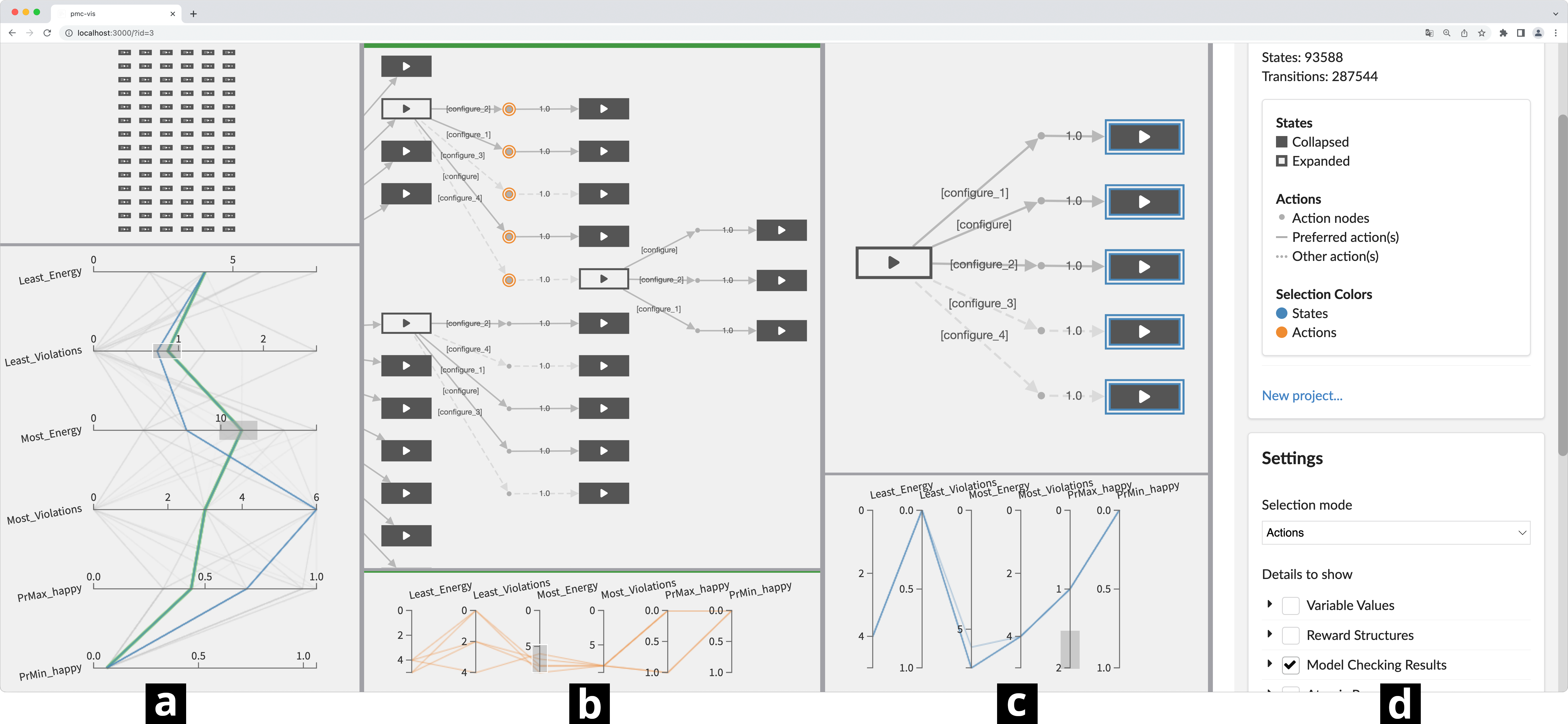
pmc-vis as a visualization tool for probabilistic models and it supports the exploration of large multivariate decision graphs, formal verification, and debugging.
Core Publication

@inproceedings{pmc-vis-2023,
author = {Max Korn and Juli\'{a}n M\'{e}ndez and Sascha Kl\"{u}ppelholz and Ricardo Langner and Christel Baier and Raimund Dachselt},
title = {PMC-VIS: An Interactive Visualization Tool for Probabilistic Model Checking},
booktitle = {Software Engineering and Formal Methods},
series = {Lecture Notes in Computer Science},
volume = {14323},
year = {2023},
month = {11},
location = {Eindhoven, Netherlands},
doi = {10.1007/978-3-031-47115-5_20},
publisher = {Springer}
}Weitere Materialien
Run the Application / Get the Prototype
Our tool pmc-vis is free and open source.
- GitHub repository with source code: https://github.com/imldresden/pmc-vis
- DOI to the reproducibility package in Zenodo: https://doi.org/10.5281/zenodo.8172531 (This package includes the docker images, experiments, source code and instructions on how to replicate our results)
On this page
Tool and Walkthrough Videos
The following video was used for onboarding and training purposes in a qualitative user study on pmc-vis.
…
Previous Versions of pmc-vis
With a previous version of pmc-vis, we also prepared videos illustrating usage scenarios.
Scenario 1: Intro to the Server Management System + Finding good initial configurations
Scenario 2: Understanding the model behavior by finding patterns
Scenario 3: Reconfiguration and schedulers
Related Student Theses

Concepts for Progressive Large Multivariate Graph Comparison
Vinzenz Fuhrmann 4. September 2025 bis 5. Februar 2026
Betreuung: Julián Méndez, Raimund Dachselt

Concepts for Linking Partial Degree-of-Interest Graphs for Large, Multivariate Graph Visualization and Exploration
Clarisa Sanjaya 16. Oktober 2023 bis 1. April 2024
Betreuung: Julián Méndez, Raimund Dachselt

Entwurfskonzepte zur Pfadfindung und Zyklusvermeidung bei der Erkundung großer multivariater Graphen
Philipp McAllister 31. Januar 2025 bis 17. April 2025
Betreuung: Julián Méndez, Raimund Dachselt

Developing concepts for visual, interactive, and scalable graph comparison
Lea Meding 1. Mai 2023 bis 2. Oktober 2023
Betreuung: Julián Méndez, Raimund Dachselt
Acknowledgements
This work was supported by the Deutsche Forschungsgemeinschaft (DFG, German Research Foundation) under Germany’s Excellence Strategy: EXC-2068, 390729961 – Cluster of Excellence „Physics of Life“ and EXC 2050/1, 390696704 – Cluster of Excellence „Centre for Tactile Internet“ (CeTI) of TU Dresden, by DFG grant 389792660 as part of TRR 248 – CPEC (see https://cpec.science) and by the Federal Ministry of Research, Technology and Space (BMFTR, SCADS22B) and Saxon State Ministry for Science, Culture and Tourism (SMWK) by funding the competence center for Big Data and AI „ScaDS.AI Dresden/Leipzig“.