Announcements/News

Goals of the Lecture

  • Deeper knowledge and understanding of interactive information visualizations in various usage scenarios
  • Ability to select and redevelop appropriate visualization and interaction techniques based on tasks, users, and environments
  • Systematic analysis and evaluation of existing information visualization solutions
  • Advanced knowledge in the field of scientific work

Topics of the Lecture

  • Spectrum of advanced interactive information visualization for multivariate data as well as structural and hierarchical data
  • Advanced techniques for managing large amounts of information: Zoomable user interfaces, multiple views, focus+context techniques
  • Comprehensive overview of modern information visualization environments and suitable interaction techniques within these environments
  • Basic understanding on other further research-related topics for interactive information visualizations
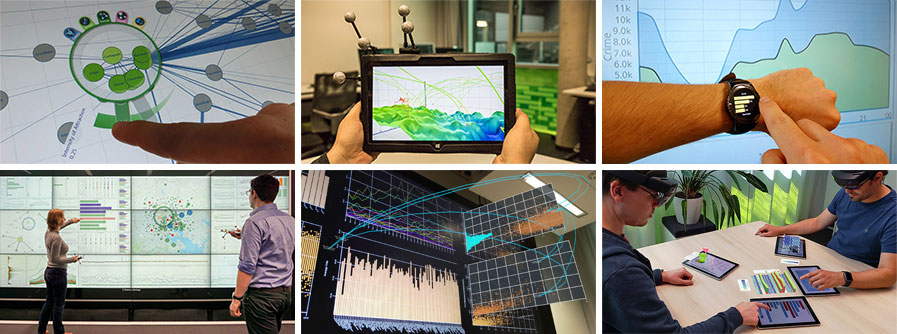
Examples of interactive visualization environments: [top-left] touch interactions for magic lenses (MultiLens); [top-center] spatial interaction with tablet computers (Mobile3DVis); [top-right] combining smartwatches and large displays (David Meets Goliath); [bottom-left] collaborative work using large displays (MCV DisplayWall); [bottom-center] personal augmented reality on large interactive displays (PARVIS); [bottom-right] mobile devices and augmented reality (MARVIS);

OPAL

The class will be managed via OPAL (incl. lecture slides, course work assignments, materials, etc.).

Enrollment

1. Please enroll via your respective enrollment system (in general this is SELMA). This is a prerequisite if you wish to take an examination for this class.

2. In order to access the lecture materials and complete the exercise assignments, you must also register in the OPAL course mentioned above.

Questions & Contact

You are welcome to ask questions about the content or the organization of the class at the end of a lecture session.

You can also join our Matrix room (#infovis26:tu-dresden.de) to discuss any organizational or topic-related aspects of the class with teachers and fellow students.

Finally, you can also use the forum in the OPAL course (link above), or contact the responsible course work / exercise instructors via email.